Catalyst testing is a crucial process in the development of efficient chemical reactions. Understanding the performance of catalysts can lead to significant improvements in industrial processes. The right testing technique can reveal valuable insights about catalyst activity, selectivity, and stability.
Various methods are available for catalyst testing, each with its own strengths and weaknesses. Some techniques are highly sophisticated, while others are relatively simple. This variety can be overwhelming, and choosing the best method requires careful consideration. Factors such as reaction environment, catalyst properties, and desired outcomes play a vital role in this selection process.
Researchers must be aware that no single method fits all scenarios. Each technique has limitations and may miss critical data. Therefore, a combination of approaches might be necessary to achieve comprehensive results. With this understanding, let's explore the top ten catalyst testing techniques that can enhance your research and development efforts.

Catalyst testing techniques play a crucial role in the development and optimization of chemical processes. Understanding these techniques is essential for researchers and industry professionals alike. The most common methods include activity testing, selectivity assessment, stability analysis, and deactivation studies. Each technique provides unique insights into catalyst performance.
Often, dynamic testing methods are seen as more effective. However, static tests can reveal important aspects too. A study highlighted that nearly 40% of catalyst assessments overlook long-term deactivation patterns. As competing reactions can complicate measurements, be aware of how reaction conditions impact data. Ensuring conditions are as close to real-world applications significantly affects results.
Tips: Always calibrate your equipment before starting tests. Accurate readings enhance reliability. Also, consider varying your testing environment. Small modifications can lead to big differences in outcomes. Understanding environmental impacts and catalyst interactions is crucial. Collecting diverse data will improve your overall understanding of catalyst behavior.
Catalyst testing plays a crucial role in optimizing chemical processes. Effective catalysts can significantly enhance reaction rates. This leads to improved efficiency and reduced costs. In industries, proper catalyst testing can determine overall process viability. It also helps in minimizing waste and byproducts. Each catalyst holds unique properties, which means tailored testing is essential.
Different techniques can reveal various insights. For example, temperature, pressure, and reactant concentration all affect catalyst performance. Testing under varying conditions allows for a deeper understanding of how catalysts behave. However, not every technique will suit every catalyst. Some tests may overlook important details. Careful selection is vital to avoid misleading conclusions.
Failures in catalyst testing can be costly. Unexpected results often require revisiting the experimentation process. Each setback can reveal unaddressed variables. Acknowledging these imperfections fosters better understanding. Continuous improvement is a key aspect of effective catalyst development. Embracing these challenges can lead to breakthroughs in chemical processes.
This chart illustrates the significance of various catalyst testing techniques used in chemical processes. Understanding these techniques is crucial for optimizing reaction conditions, improving catalyst performance, and ensuring desired outcomes in industrial applications.
Catalyst performance evaluation is crucial in various industries. Methods such as temperature-programmed reduction (TPR) and temperature-programmed oxidation (TPO) are popular for assessing metal catalysts. TPR helps analyze the reducibility of catalysts by measuring hydrogen consumption. In a study, it was found that TPR can effectively distinguish between different catalyst formulations, improving overall product yields.
Another common method is catalytic activity measurement under steady-state conditions. This approach evaluates how efficiently a catalyst converts reactants into products. According to a report by the Global Catalysts Market, steady-state testing ensures consistent data. Yet, this method can overlook transient effects that impact catalyst behavior during real-time operations.
Heterogeneous catalysis often employs reaction kinetics study through techniques like pulse reaction analysis. This provides insight into the active sites and their interactions over time. Despite its advantages, this technique sometimes struggles to replicate conditions found in large-scale applications. It is essential to address these limitations in catalyst testing to ensure accurate predictions of performance in practical scenarios.
When setting up an experiment for catalyst testing, the parameters you choose are crucial. Start by defining the reaction conditions clearly. Temperature, pressure, and reactant concentrations greatly impact catalyst performance. A small variation in temperature can lead to different reaction rates. It's essential to maintain these conditions consistently.
Monitor the reaction meticulously. Record data on conversion rates and selectivity at regular intervals. This will help you understand how various parameters affect your catalyst's effectiveness. It’s vital to analyze these changes closely—sometimes the trends are not as expected, leading to critical insights.
Tips: Always calibrate your equipment before the tests. Small calibration errors can result in significant data discrepancies. Also, consider running multiple trials. Variability in results can highlight the need for further reflection on your experimental setup. Lastly, documenting everything in detail can be very helpful for future experiments, even if things don’t go as planned.
| Technique | Application | Key Parameters | Advantages | Limitations |
|---|---|---|---|---|
| Temperature Programmed Reduction (TPR) | Characterization of metal catalysts | Heating rate, gas flow rate | High sensitivity to metal oxidation states | Requires careful calibration |
| Temperature Programmed Oxidation (TPO) | Evaluation of catalyst stability | Heating rate, oxygen concentration | Provides insight into carbon deposits | May not distinguish between different carbon forms |
| Catalytic Activity Measurements | Assessment of catalyst performance | Pressure, temperature, reactant concentration | Direct measurement of activity | Requires controlled experimental conditions |
| Infrared Spectroscopy (IR) | Surface reaction monitoring | Wavenumber range, temperature | Non-destructive analysis of active sites | Limited to gases and surface species |
| X-Ray Diffraction (XRD) | Phase identification of catalysts | Scan rate, angle range | Identifies crystalline structures | Cannot provide information on amorphous phases |
| X-Ray Photoelectron Spectroscopy (XPS) | Surface composition analysis | Photon energy, angle | Elemental and chemical state information | Requires ultra-high vacuum conditions |
| Scanning Electron Microscopy (SEM) | Morphological analysis | Voltage, vacuum level | High-resolution imaging of surface structures | Surface conductivity required |
| Thermogravimetric Analysis (TGA) | Decomposition and stability assessment | Heating rate, atmosphere | Quantitative weight loss data | Requires interpretation of complex data |
| Nitrogen Physisorption | Surface area measurement | Temperature, nitrogen pressure | Reliable surface area and pore size data | Does not provide information on chemical identity |
| Catalyst Screening | Comparative evaluation of multiple catalysts | Reaction conditions, catalyst loadings | Efficient identification of top performers | Requires a robust experimental design |
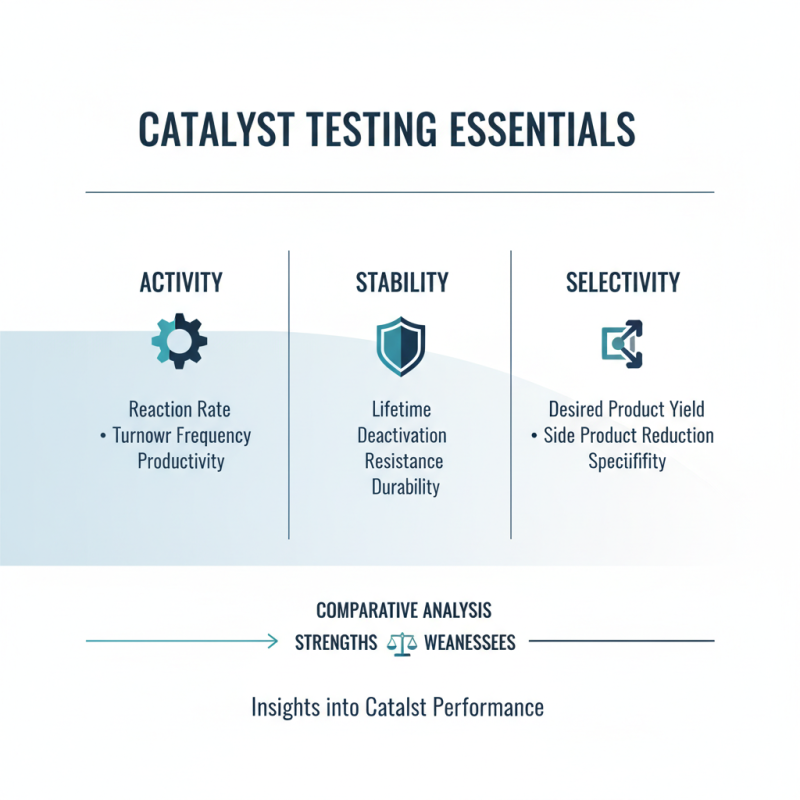
Catalyst testing is essential in the field of catalysis. Various techniques provide insights into catalyst performance. Some methods focus on activity, while others assess stability or selectivity. Comparative analysis reveals the strengths and weaknesses of each approach.
For example, temperature-programmed reactions can analyze how catalysts respond under varying conditions. However, it may oversimplify complex reactions. On the other hand, in situ spectroscopy offers real-time insights but can require advanced equipment. While these methods have their advantages, challenges in reproducibility exist.
Additionally, microreactor technology allows for precise control over reaction parameters. But the scale may limit the ability to mimic industrial processes accurately. Ultimately, understanding these techniques and their contexts is crucial. Each method sheds light on different aspects of catalyst behavior, leading to better overall insights.